Unearthing Genius: Ice Age China's Unexpected Technological Leap
Archaeologists working at the Lingjing site in central China have made a remarkable discovery, rewriting our understanding of early human ingenuity. Evidence suggests that an ancient human group, identified as Homo juluensis, crafted sophisticated stone tools 146,000 years ago – a period previously believed to be a harsh ice age. This finding profoundly challenges the notion that human creativity and technological advancement primarily emerge during times of environmental stability and abundance.
Yuchao Zhao, assistant curator of East Asian archaeology at the Field Museum and lead author of the study published in the Journal of Human Evolution, emphasizes the significance: “People often imagine creativity as something that flourishes in good times. Finding out that these stone tools were made during a harsh ice age tells a different story. Hard times can force us to adapt.”
Masterful Craftsmanship: Beyond Simple Stone Chipping
For years, many archaeologists assumed that early humans in East Asia during the late Middle Pleistocene (300,000-120,000 years ago) exhibited limited technological development compared to their counterparts in Africa and Europe. The Lingjing discoveries are dismantling this assumption.
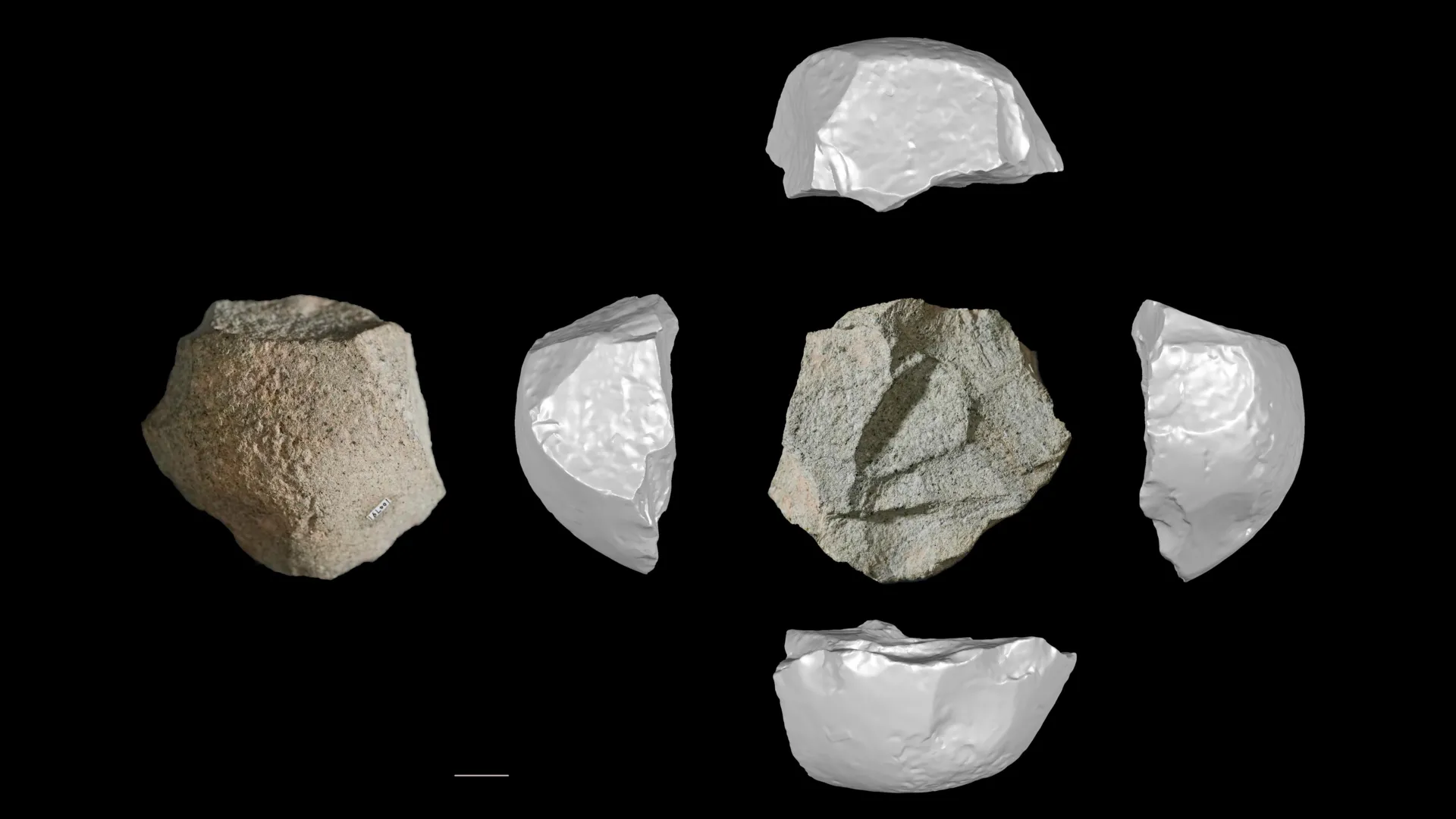
The stone tools, particularly the disc-shaped cores, may not appear extraordinary at first glance. However, meticulous analysis reveals a highly organized manufacturing process. Homo juluensis carefully struck smaller stones against larger cores to produce precise cutting flakes. Some cores were worked symmetrically, while others demonstrated an asymmetrical design, with one side serving as a striking platform and the other prepared for flake production. This level of intentional design showcases a deep understanding of stone properties and fracture mechanics.
“This was not casual flake production, but a technology that required planning, precision, and a deep understanding of stone properties and fracture mechanics,” Zhao explains. “The underlying logic of this system — and the cognitive abilities it reflects — shows important similarities to Middle Paleolithic technologies often associated with Neanderthals in Europe and with human ancestors in Africa, suggesting that advanced technological thinking was not limited to western Eurasia.”
A Cold Revelation: Dating the Past with Crystal Clocks
A crucial aspect of this research involved accurately dating the Lingjing site. Archaeologists uncovered numerous animal bones alongside the tools, indicating that the site was likely a butchering ground for animals like deer. Within one deer rib bone, sparkling calcite crystals held the key to unlocking the site’s true age.
Calcite crystals naturally contain trace amounts of uranium, which slowly decays into thorium over vast periods. By measuring the ratio of these two elements, scientists can precisely determine the age of the crystal formation. This innovative dating method pushed the site’s age back significantly.
The Paradox of Progress: Creativity Forged in Adversity
Previous estimates suggested the Lingjing tools were no older than approximately 126,000 years, placing them within a relatively warmer interglacial period. However, the new crystal analysis revised the age to around 146,000 years ago. This seemingly small difference dramatically alters the environmental context.
“Even though these tools are just a little bit older than we’d previously thought, the entire story is changed,” says Zhao. “During the Pleistocene, Earth repeatedly shifted between colder ice-age periods and warmer intervals between them. We used to think these tools were made 126,000 years ago, during a warm interglacial period, but based on the new dates suggested by the crystals, some of these tools were actually produced 146,000 years ago, during a harsh, cold glacial period.”
The revised timeline paints a vivid picture: these ancient humans were developing complex technology not in comfort, but while battling extreme environmental stress. This suggests that hardship itself may have acted as a powerful evolutionary driver, fostering innovation and adaptability rather than hindering it.
This research enriches our understanding of human evolution, intelligence, and resilience in East Asia, demonstrating that the capacity for sophisticated thought and problem-solving is a hallmark of our ancient ancestors, even in the most challenging environments.